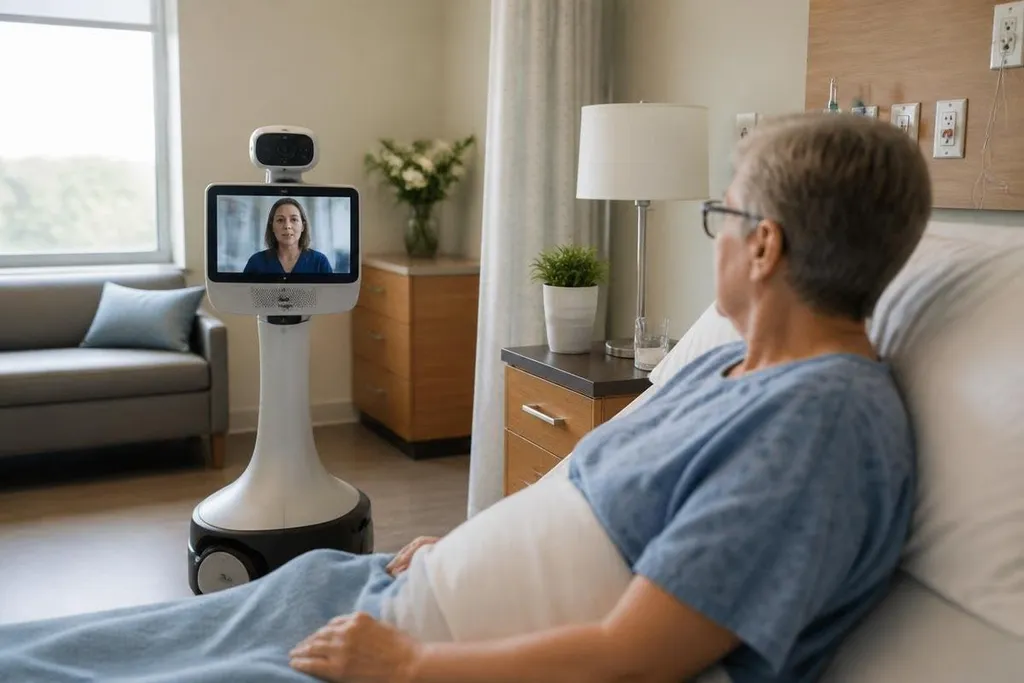
A remote monitoring robot could move through a patient’s room, carry a camera and microphone, and connect a person at home with a care team. Its value depends on what it can notice safely, how often a human checks the data, and what happens when the connection fails.
- A mobile robot can bring video calls and basic checks into the patient’s room.
- Sensors can spot changes, but they don’t replace clinical judgment.
- Privacy, consent, charging, and network failure need answers before home use.
What the robot would actually do
The simplest system is a mobile base with a screen, camera, microphone, speaker, and wireless connection. A patient could use it for a scheduled video visit without walking to a computer or holding a phone.
A more capable system could move between rooms, avoid furniture, and return to a charging dock. Its navigation software would need a map of the home and a safe way to handle people, pets, loose cables, and narrow doorways.
Sensors could add useful context. A camera might show whether a patient is sitting or has fallen. A microphone could carry a conversation or detect a call for help. Other sensors could track room temperature or movement, but each added sensor creates another question about accuracy and privacy.
The robot should send a clear alert when a reading falls outside a set range. It shouldn’t quietly turn that alert into a medical decision. A nurse, doctor, or family member still needs to check what happened and decide what to do.
Where remote monitoring helps
Remote care works best when the robot removes a practical barrier. Someone recovering at home may have trouble reaching a phone, adjusting a camera, or explaining a change during a short call. A mobile platform can bring the conversation to them.
It may also help a care team check on several scheduled visits without sending staff to every room. That does not remove the need for physical visits. It can make a remote check easier when travel is difficult or a patient needs frequent contact.
For industry readers, the useful question is not whether a robot looks friendly on a video call. It is whether the system records the right signal, sends it to the right person, and fits the care process.
A remote patient-monitoring robot can send an alert, but the care team still needs to know what triggered it and who acts next. A dated report from Robot 24 can tie that alert to the robot’s sensor, test setting, and response plan. Those details matter before remote monitoring meets the limits of real care.
The limits are serious
A camera may miss a fall behind a bed or mistake a normal movement for a warning. A microphone may struggle with background noise. A mobile robot may stop when a doorway is blocked, its battery is low, or its network link drops.
Remote monitoring also changes the patient’s private space. People need to know when the camera is active, who can view the feed, how long data remains available, and whether the robot records by default. Consent must be clear enough for a patient to change their mind.
Cybersecurity matters because the robot connects a physical machine to health data. Access controls, software updates, secure communications, and a manual stop function all belong in the design. A failure should leave the robot in a safe state and tell a human what went wrong.
I'd judge a system by its missed alerts and false alarms, not by a smooth demonstration. A robot that creates more calls for staff may add work while appearing helpful.
A buying and trial checklist
Before a hospital, care provider, or home-care team starts a trial, check these points:
- Define the task: Decide whether the robot handles video visits, room checks, alerts, or a narrow mix of jobs.
- Name the responder: Set the person who receives each alert and the time they have to act.
- Test the home: Check door widths, floor changes, lighting, noise, Wi-Fi coverage, and charging access.
- Set privacy rules: Tell patients when sensors run, who sees the data, and when records are deleted.
- Plan failure: Test low battery, lost connection, blocked paths, sensor errors, and manual shutdown.
- Measure results: Track missed alerts, false alarms, response time, patient acceptance, and staff workload.
That last measure matters. A remote robot earns its place only when it helps a care team respond sooner or reach people more often without adding unsafe work.
The next proof should come from supervised trials that report those measures, not from a video of a robot crossing a room. Until that data is public, remote patient monitoring robots remain useful tools to test, not replacements for clinical care.